
Story - 01
↓
What is lacquer?
Urushi refers to the sap extracted from the lacquer tree.
A lacquer tree takes 10 to 15 years to grow, and its sap comes from a single tree.
Only 200ml can be collected.
People have cultivated lacquer trees in the mountains and used their sap as a blessing to support their lives. This relationship between humans and lacquer has continued for an incredibly long time.

The miraculous properties of lacquer
Lacquer is applied, sanded, and hardened repeatedly, building up layers upon layers. The resulting lacquer coating is very strong, chemically stable, and extremely durable.
Furthermore, lacquer has the property of firmly holding the painted surface in place. In Japan, the world's oldest lacquer has been found in a Jomon period site dating back 9,000 years, remaining intact and vividly colored. This indicates that lacquer, which is originally a plant, has the property of not being decomposed even by microorganisms.
Lacquer possesses durability, heat insulation, and corrosion resistance far exceeding expectations. It is also resistant to acids, alkalis, and alcohol, and has antibacterial and germicidal properties. To this day, no synthetic paint has been developed that surpasses lacquer. Furthermore, lacquer is an excellent adhesive, and its use in "kintsugi," a traditional Japanese art of repairing broken pottery with gold, is gaining attention internationally, leading to a global increase in interest in its properties.
The meaning of applying lacquer
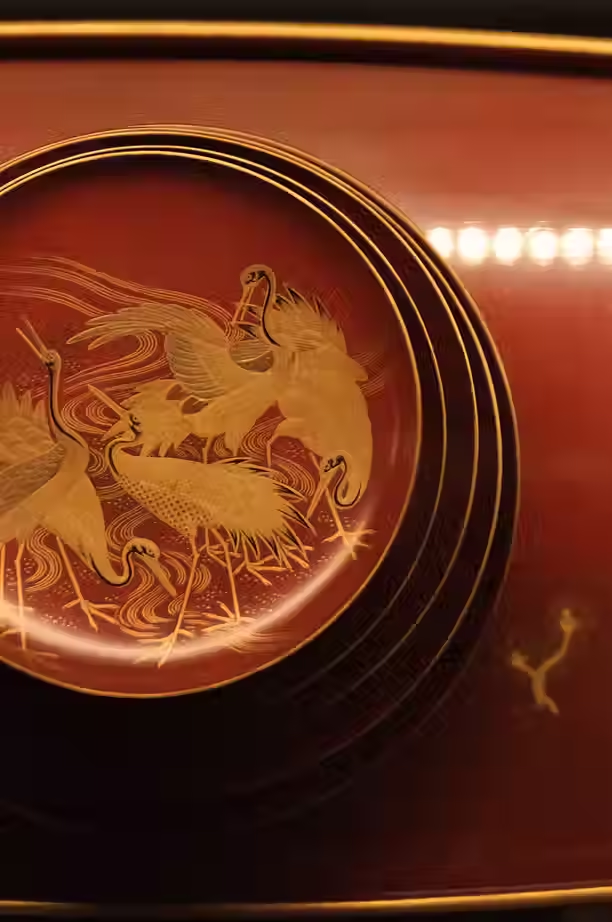
Lacquerware was once known as "JAPAN" overseas, and was renowned as a representative traditional craft of Japan, developing along with its techniques and beauty. Lacquer has also been used in the restoration of national treasures and important cultural properties, playing a significant role in the preservation of Japanese history and artistic culture.
However, in the Jomon period, when lacquer culture is believed to have begun, lacquer was not used to adorn works of art that expressed beauty or sublimity, but rather primarily for the simple desire to preserve important things through the application of lacquer.
In today's world, we create new things every day. Every object, regardless of its era, is a part of our history, and everything has a reason for existing and a value. However, in reality, the world is overflowing with things that have nowhere to go, and these continue to burden the global environment.
Items with outdated designs that don't fit the current trends, items whose value has decreased due to scratches or chips, items that never made it to the sales floor, and items that are being stored away somewhere because they can't be thrown away.
Applying lacquer to such objects offers more than just a cosmetic renewal. Lacquer, a precious tree sap, provides the aforementioned durability, insulation, and preservative properties, giving the object the potential to last for a very long time. Furthermore, as time passes, the lacquer hardens the surface, its color deepens, and its luster becomes even more brilliant.

04 - The Role of Decomposers in Society
Using lacquer in everyday life and passing it on to future generations—this is the true charm of lacquer, the wisdom inherited from the Jomon people 10,000 years ago, and the essence of this project. We hope that by learning about the benefits of lacquer, people will be inspired to truly consider how to communicate with nature again and live in harmony with it.

Sotry-01: Coexistence with lacquer

Urushi refers to the sap extracted from the lacquer tree.
It takes 10 to 15 years for a lacquer tree to grow, and only about 200 ml of sap can be harvested from a single tree.
People have cultivated lacquer trees in the mountains and used their sap as a blessing to support their lives. This relationship between humans and lacquer has continued for an incredibly long time.